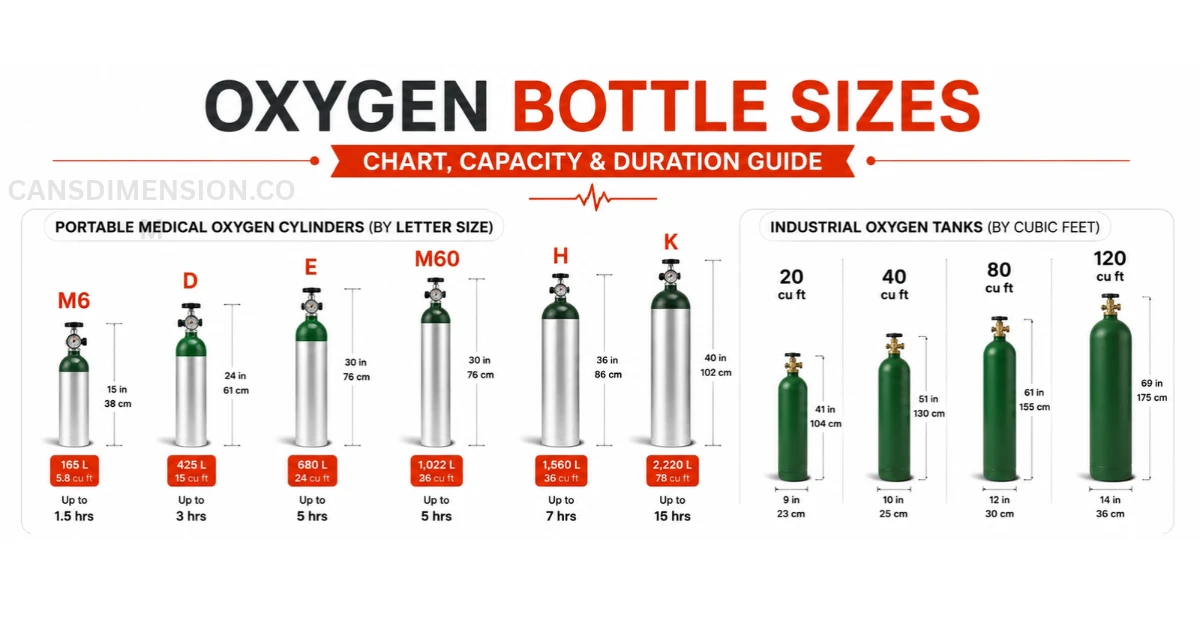
Oxygen bottle sizes are named by letters such as M6, D, E and H/K, and industrial tanks are named by cubic feet. The size sets how much gas a tank holds and how long it lasts.
Oxygen Tank Sizes Chart (Medical Cylinders)
Most small medical oxygen cylinders are aluminum, and the big H/K is steel. Figures below come from US supplier data, and cubic feet are my conversions (1 cu ft ≈ 28
Oxygen Cylinder Sizes, Dimensions, Pressure, and Weight Chart
Size
Liters
≈ Cu ft
PSI
Height (in)
Diameter (in)
Weight (lb)
M6 (B)
165
5.8
2,200
15
3.2
2.8
M9 (C)
255
9
2,000
14.1
4.38
3.7
D
425
15
2,000
20
4.38
5.3
Jumbo D
640
22.6
2,000
20
5.25
8.1
E
680
24
2,000
29
4.38
7.9
M60
1,738
61
2,200
23
7.25
21.7
MM
3,455
122
2,200
35.75
8
38.6
H/K
7,842
277
2,000
55
9
120
Divide the liters by the flow rate (LPM), then divide by 60. A D tank at 2 LPM gives 425 ÷ 2 ÷ 60, or about 3.5 hours.
Real charts leave a safety reserve, so treat the math as a ceiling. The table below uses Tri-Med’s published run times. The pulse figure assumes a conserver at 20 breaths per minute.
Size
1 LPM
2 LPM
4 LPM
Pulse dose at 1 LPM
M6
2.7 h
1.4 h
0.7 h
16.3 h
M9
4.0 h
2.0 h
1.0 h
24.1 h
D
6.9 h
3.5 h
1.7 h
41 h
E
11.4 h
5.7 h
2.8 h
64.4 h
Pulse dose delivers oxygen only when you breathe in, so it stretches the supply several times over. A doctor sets your flow rate. Plan a refill or swap before the gauge nears empty.
Medical vs Industrial Oxygen Bottle Sizes
Medical cylinders use letter sizes, aluminum bodies and CGA 870 valves on the small sizes. US sellers require a doctor’s prescription for medical oxygen.
Industrial tanks are sold by cubic feet, usually in 20, 40, 80, 125, 250 and 300 cu ft steel. They use a CGA 540 valve (3/4″ NGT thread) and suit welding, cutting and brazing. They are not meant for breathing.
How to Choose the Right Oxygen Cylinder Size
Match the oxygen cylinder size to where and how you use it. For walks and travel, M6, M9 or D keeps the weight low.
Check these before you buy:
Flow rate and hours needed: use the formula above.
Weight you can carry: an E weighs 7.9 lb, while an H/K weighs 120 lb.
Refill access: cylinders ship empty, and some suppliers only swap tanks, not refill yours.
Test date: a hydrostatic test is due every 5 or 10 years, and a star after the date means 10 years.
Ownership: leased tanks can’t be resold, and markings such as DOT 3AL show approval.
Safety basics: store tanks upright and secured. Keep oxygen away from oil, grease, flames and fuel gas such as acetylene. Use only an oxygen-rated regulator.
Oxygen Bottle Sizes FAQs
What are the standard oxygen bottle sizes?
Common medical oxygen bottle sizes include M6, M9, D, Jumbo D, E, M60, MM, and H/K. Industrial oxygen cylinders range from 20 to 300 cubic feet.
What is the most common oxygen tank size for home use?
M6, M9, and D tanks are popular for portable use, while E-size tanks are often used as home backups. Your doctor and oxygen supplier can help determine the right size.
How long does a D-size oxygen tank last?
A D-size oxygen tank lasts approximately 3.5 hours at 2 LPM with continuous flow. With a pulse-dose conserver set at 1 LPM, it may last around 41 hours.
What is the difference between CGA 870 and CGA 540?
CGA 870 fittings are used for smaller medical oxygen tanks, typically M2 through E. CGA 540 fittings are used for larger medical and industrial cylinders, such as M60, MM, and H/K.
How many cubic feet is an E oxygen tank?
An E-size oxygen tank holds approximately 22–24 cubic feet, or around 680 liters. Exact capacities vary slightly by manufacturer.
Can I use an industrial oxygen tank for breathing?
No. Industrial oxygen is intended for applications such as welding and cutting. Medical oxygen must come from an authorized medical oxygen supplier and meet medical standards.
Do I need a prescription to buy an oxygen cylinder?
In the United States, medical oxygen generally requires a prescription from a licensed healthcare provider. Requirements may vary by location and supplier.
How much does a large oxygen cylinder weigh?
An H/K oxygen cylinder weighs approximately 120 lb, an MM cylinder about 38.6 lb, and a 300 cu ft steel cylinder roughly 126–143 lb.
My name is Shehzad Ali. I am the admin and author of cansdimension.com. I write simple guides about can sizes and dimensions. I share information to help readers understand cans.