An ammo can measures
12 inches long,
6 inches wide, and
7.5 inches tall.
But that’s just the starting point. Ammo cans also come in compact, medium, and military-grade storage sizes designed for ammunition, tools, emergency kits, and outdoor gear.
From the compact 30 cal M19A1 to the massive 20mm heavy can, every size has precise specs that affect shelf clearance, vehicle storage, stacking capacity, and round count planning.
Ammo Can Dimensions Chart
Can Type
External (L × W × H)
Internal (L × W × H)
Empty Weight
NSN
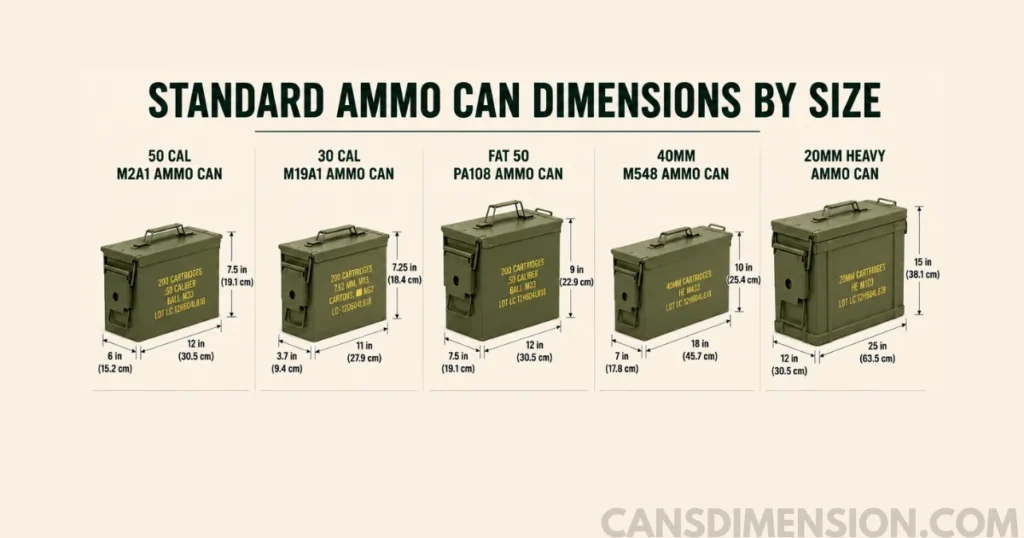
30 Cal (M19A1)
11″ × 3.7″ × 7.25″
10″ × 3.5″ × 6.5″
4 – 5 lbs
8140-00-960-1699
50 Cal (M2A1)
12″ × 6″ × 7.5″
11″ × 5.5″ × 7″
5 – 6 lbs
8140-00-828-2938
Fat 50 (PA108)
12″ × 7.5″ × 9″
11″ × 7″ × 8.5″
~7 lbs
8140-01-347-8126
40mm (M548)
18″ × 7″ × 10″
17″ × 6.5″ × 9.5″
~12 lbs
8140-00-739-0230
20mm Heavy
25″ × 12″ × 15″
24″ × 11″ × 14″
25 – 30 lbs
Varies
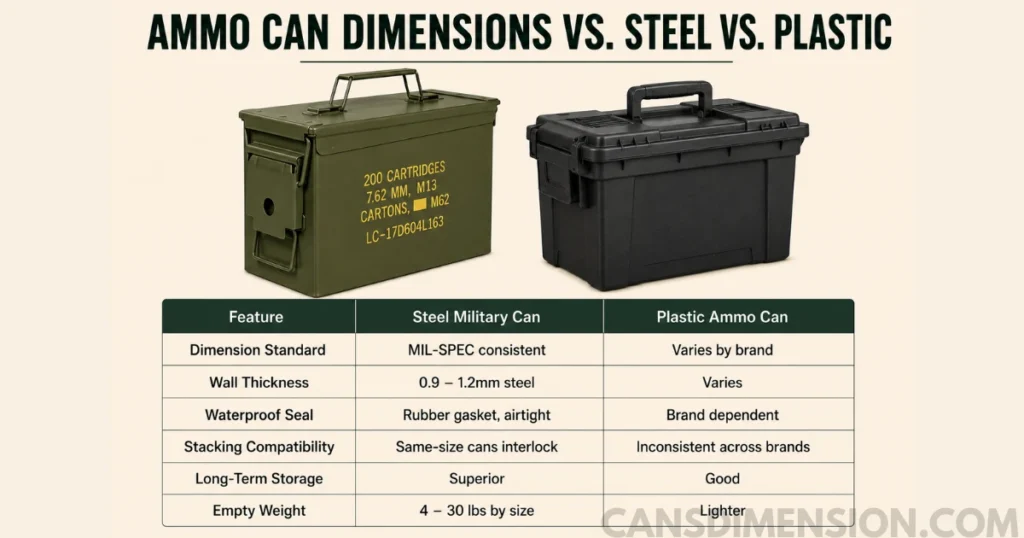
All measurements follow MIL-SPEC standards used across US military surplus manufacturing. All genuine military-surplus ammo cans are built from heavy-gauge steel (0.9 to 1.2mm thick), feature a rubber gasket seal, and are both waterproof and airtight.
Not all ammo cans are the same. Each size has a specific purpose, a specific audience, and specific numbers that matter for storage and portability planning.
50 Cal M2A1 Ammo Can Dimensions (The Standard)
It measures 12 inches long, 6 inches wide, and 7.5 inches tall externally. The usable interior drops to 11 × 5.5 × 7 inches. Empty weight runs 5 to 6 pounds.
30 Cal M19A1 Ammo Can Dimensions
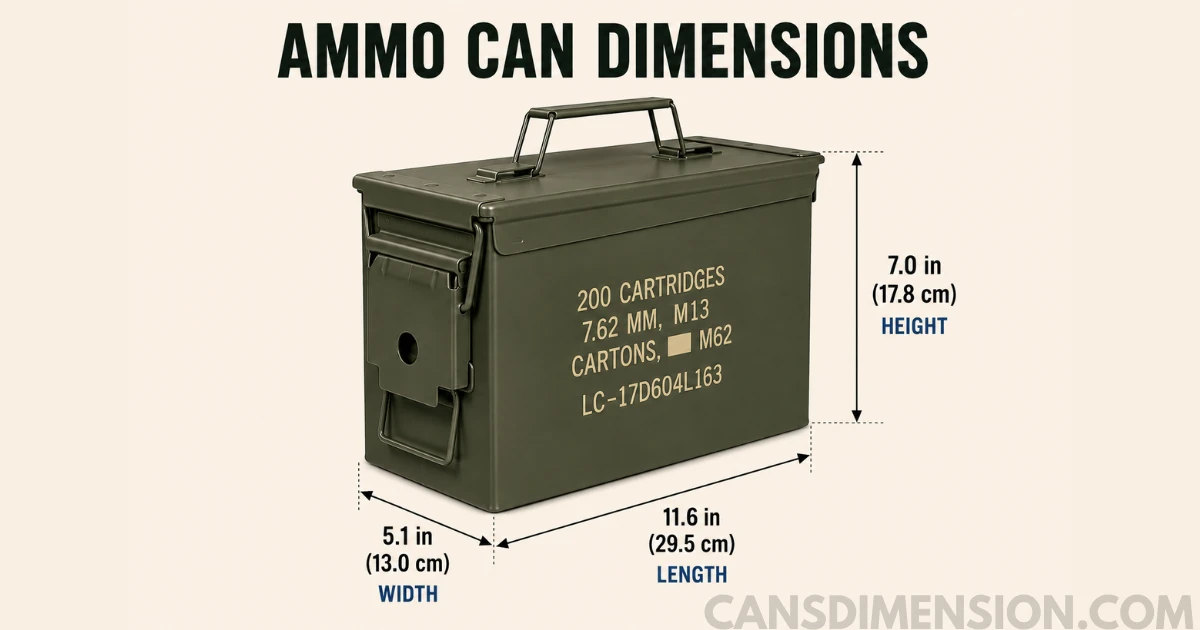
It measures 11 inches long, 3.7 inches wide, and 7.25 inches tall externally. The usable interior drops to 10 × 3.5 × 6.5 inches. Empty weight runs just 4 to 5 pounds — the lightest standard size available.
Fat 50 PA108 Ammo Can Dimensions
It measures 12 inches long, 7.5 inches wide, and 9 inches tall externally — sharing the same length as the standard 50 cal but noticeably wider and taller. The usable interior drops to 11 × 7 × 8.5 inches. Empty weight runs approximately 7 pounds.
40mm M548 Ammo Can Dimensions
It measures 18 inches long, 7 inches wide, and 10 inches tall externally. The usable interior drops to 17 × 6.5 × 9.5 inches. Empty weight runs approximately 12 pounds.
20mm Heavy Ammo Can Dimensions
At 25 inches long, 12 inches wide, and 15 inches tall externally, the 20mm steps into an entirely different weight class. The usable interior measures 24 × 11 × 14 inches. Empty weight runs 25 to 30 pounds — the heaviest standard ammo can format.
External vs Internal Ammo Can Dimensions
Can Type
External Length
Internal Length
Space Lost
30 Cal (M19A1)
11″
10″
1″
50 Cal (M2A1)
12″
11″
1″
Fat 50 (PA108)
12″
11″
1″
40mm (M548)
18″
17″
1″
20mm Heavy
25″
24″
1″
Steel wall thickness ranges from 0.9mm to 1.2mm depending on the can size. Larger cans use thicker steel, which means proportionally more space is lost on width and height as well — not just length.
For shelf clearance, add 1 inch above each can’s exterior height to account for handle clearance when lifting. A 50 cal can at 7.5 inches tall needs at least 8.5 inches of vertical shelf space to remove and replace without struggle.
Steel military-surplus cans and civilian plastic cans serve the same purpose — but their physical consistency is very different.
Stacking comparison: Same-size steel cans stack perfectly — the lids and bases are designed to interlock. Mix sizes and you get instability. For loaded 50 cal cans, a maximum of three-high is the practical safe limit. Beyond that, the bottom can’s handle takes structural stress. Plastic cans from different brands do not reliably interlock, making mixed stacking a stability risk.
Question’s
What are the standard dimensions of a 50 cal ammo can?
The standard 50 cal M2A1 ammo can measures 12 inches long, 6 inches wide, and 7.5 inches tall externally. The usable interior is 11 × 5.5 × 7 inches. It weighs 5 to 6 pounds empty and is the most popular ammo can size in the USA.
How big is a 30 cal ammo can?
The 30 cal M19A1 measures 11 inches long, 3.7 inches wide, and 7.25 inches tall externally. The interior usable space is 10 × 3.5 × 6.5 inches. At just 4 to 5 pounds empty, it is the most portable standard ammo can format.
What is the difference between a 50 cal and Fat 50 ammo can?
Both share the same 12-inch external length, but the Fat 50 PA108 is wider at 7.5 inches versus 6 inches and taller at 9 inches versus 7.5 inches. The Fat 50 holds 25 to 30 percent more volume and was originally designed for linked belt ammunition.
How big is a 40mm ammo can?
The 40mm M548 measures 18 inches long, 7 inches wide, and 10 inches tall externally. The interior usable space is 17 × 6.5 × 9.5 inches. Its long, narrow profile makes it better suited for tools, long gear, and camping equipment than for loose round storage.
How many rounds fit in a 50 cal ammo can?
A 50 cal M2A1 holds approximately 800 rounds of 5.56 loose or around 400 rounds of 7.62 loose. Boxed ammo reduces capacity by roughly 20 to 25 percent due to factory packaging space. For maximum capacity, load loose and use a round counter.
Do ammo can dimensions vary by manufacturer?
Steel military-surplus ammo cans do not vary — they are manufactured to consistent MIL-SPEC standards. Physical height, length, width, and wall thickness measurements remain consistent across all US military surplus production. Plastic civilian ammo cans vary by brand and do not reliably match MIL-SPEC dimensions.
Why is the interior of an ammo can smaller than the exterior?
The steel walls and lid hinge mechanism reduce usable interior space on every side. Every standard ammo can loses approximately 1 inch of usable interior length compared to its external measurement. Larger cans also lose more space on width and height due to thicker steel walls — ranging from 0.9mm to 1.2mm depending on size.
How high can you safely stack 50 cal ammo cans?
A maximum of three-high is the practical safe limit for loaded 50 cal cans. Beyond that, the bottom can’s handle takes structural stress. Same-size cans stack reliably — mixing sizes creates instability and should be avoided for any stacked storage setup.
My name is Shehzad Ali. I am the admin and author of cansdimension.com. I write simple guides about can sizes and dimensions. I share information to help readers understand cans.