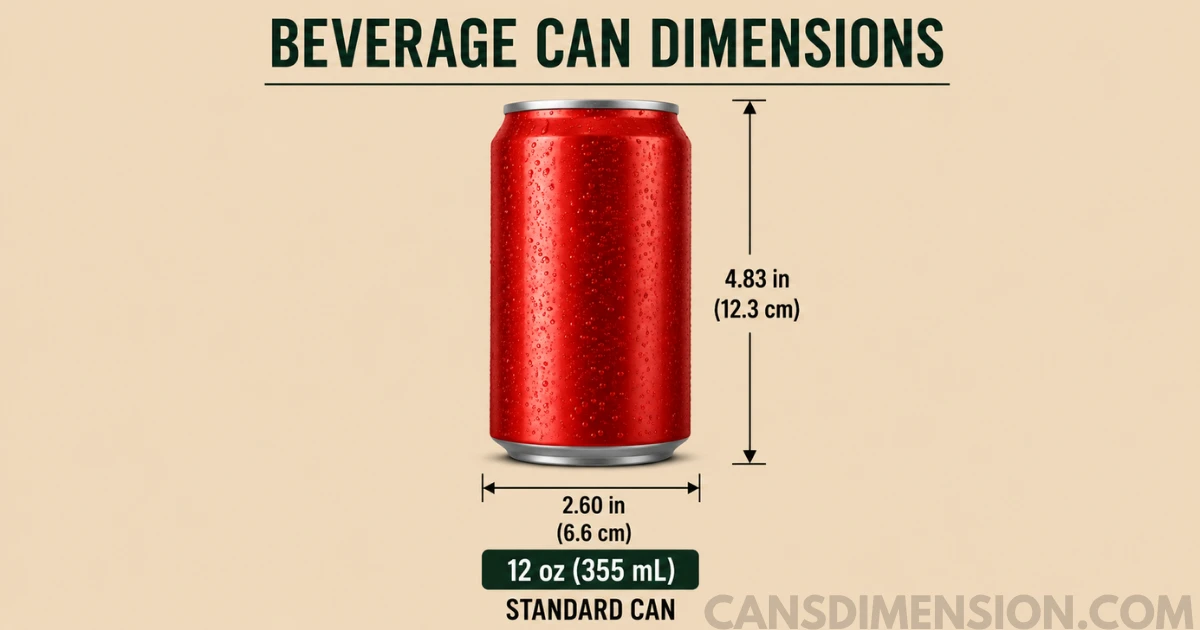
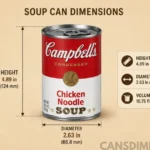
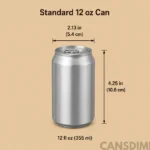
A beverage can stands
4.83 inches tall
with a
2.60-inch diameter.
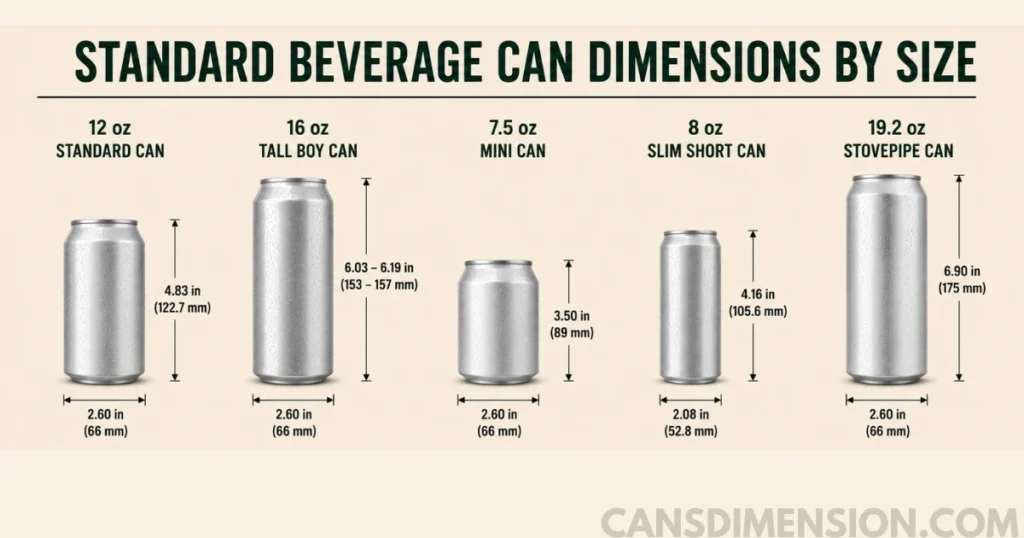
But that’s just the starting point. Beverage cans also come in mini, slim, sleek, tallboy, and stovepipe sizes for soda, energy drinks, sparkling water, beer, and ready-to-drink beverages.
From the compact 7.5 oz mini to the oversized 19.2 oz stovepipe, every size has precise specs that affect filling line compatibility, label design, pallet efficiency, and retail shelf positioning.
Beverage Can Dimensions Chart
Can Type
Height (in)
Height (mm)
Diameter (in)
Diameter (mm)
Volume (oz)
Volume (ml)
End Size
7.5 oz Mini
3.50
89
2.60
66
7.5
222
202
8 oz Slim Short
4.16
105.6
2.08
52.8
8
250
200
12 oz Standard
4.83
122.7
2.60
66
12
355
202
12 oz Sleek
6.14
156
2.25
57
12
355
202
12 oz Slim
6.61
168
2.09
53
12
355
200
16 oz Tall Boy
6.03 – 6.19
153 – 157
2.60
66
16
473
202
19.2 oz Stovepipe
~6.90
175
2.60
66
19.2
568
202
All measurements follow Can Manufacturers Institute (CMI) standards used across the US beverage industry. In 2024, over 95 billion beverage cans were filled in America alone.
Not all beverage cans are the same. Each size has a specific purpose, a specific audience, and specific numbers that matter for production and packaging.
12 oz Standard Can Dimensions (The Standard)
It stands 4.83 inches (122.7 mm) tall and measures exactly 2.60 inches (66 mm) in diameter. It holds 355 milliliters of liquid and uses a 202 end — a 54 mm lid diameter narrower than the body due to the neck-in taper at the top.
12 oz Sleek Can — Taller, Slimmer Profile
It measures 6.14 inches (156 mm) tall with a narrower 2.25-inch (57 mm) diameter — over an inch taller than the standard version but holding the same 355 ml volume. It uses the same 202 end as the standard can.
16 oz Tall Boy Can Dimensions
It stands 6.03 to 6.19 inches (153 to 157 mm) tall. The diameter stays at 2.60 inches — identical to the 12 oz standard — making it production-line compatible with standard format equipment. It holds 473 milliliters.
7.5 oz Mini Can Dimensions
It stands just 3.50 inches (89 mm) tall with a 2.60-inch diameter — the same body width as a full-size 12 oz standard. It holds 222 milliliters. The body is short, not narrow.
8 oz Slim Short Can Dimensions
It stands 4.16 inches (105.6 mm) tall with a narrow 2.08-inch (52.8 mm) diameter. It holds 250 milliliters and uses a 200 end — smaller and harder to source in North America than the standard 202 end.
19.2 oz Stovepipe Can Dimensions
It stands approximately 6.90 inches (175 mm) tall with a 2.60-inch diameter — the same body width as the 12 oz standard and 16 oz tall boy. It holds 568 milliliters.
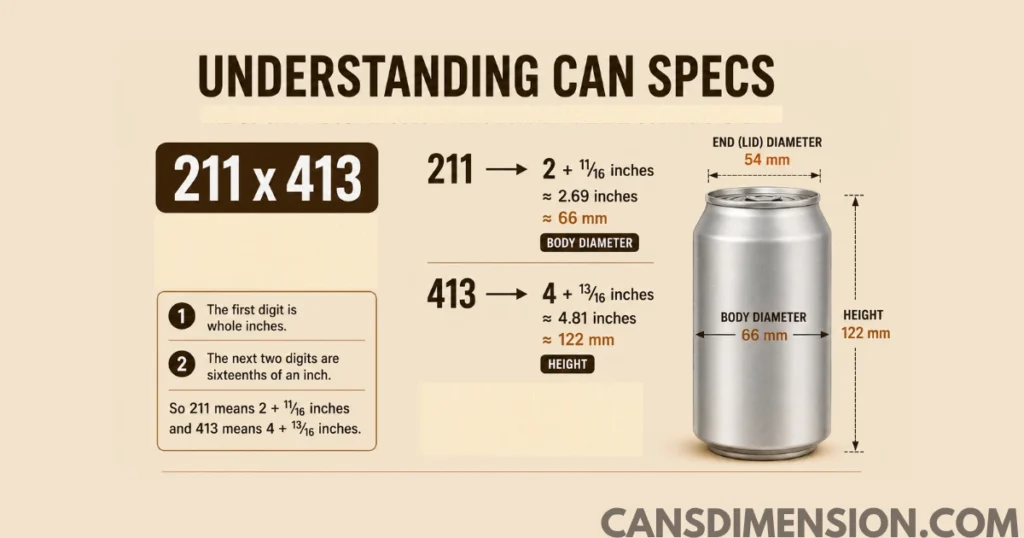
The US can industry uses a fractional Imperial coding system for can specs. The code “211 x 413” does not use millimeters or decimal inches — it uses whole inches plus sixteenths of an inch.
The first digit is whole inches. The next two digits are sixteenths of an inch. So211 means 2 + 11/16 inches —approximately 2.69 inches or 66 mm, the standard12 oz body diameter. And 413 means 4 + 13/16 inches — approximately 4.81 inches or 122 mm, thestandard 12 oz height.
The body of a standard aluminum can is 66 mm wide. The end (lid) is only 54 mm — smaller because the top of the can is necked in before the lid is attached. Your label artwork wraps around the body diameter, not the end. Printing to the wrong spec means the design gets cut off at the top.
Beverage Can Dimensions vs. Slim vs. Sleek: Key Differences
Feature
Standard
Sleek
Slim
Body Diameter
66 mm / 2.60 in
57 mm / 2.24 in
53 mm / 2.09 in
Height (12 oz)
4.83 in / 122.7 mm
6.14 in / 156 mm
6.61 in / 168 mm
End Type
202
202
200
Units per Pallet
9,725
10,120
10,166
End Availability
Universal
Universal
Limited in North America
The critical difference is the end type. Sleek cans use the same 202 end as standard cans — switching from standard to sleek requires new chucks and star wheels on the filling line but no new can end sourcing.
Question’s
What are the standard dimensions of a 12 oz beverage can?
A standard 12 oz beverage can measures 4.83 inches tall and 2.60 inches in diameter. It holds 355 ml and uses a 202 end with a 54 mm lid diameter.
How tall is a 16 oz tall boy beverage can?
A 16 oz tall boy stands 6.03 to 6.19 inches tall (153 to 157 mm). The diameter stays at 2.60 inches — the same as a 12 oz standard — for production-line compatibility.
What is the difference between a sleek and slim beverage can?
A sleek can has a 57 mm body diameter and uses a 202 end — the same as a standard can. A slim can has a narrower 53 mm body and requires a 200 end, which is harder to source in North America.
What does the industry code 211 x 413 mean on a beverage can?
It uses the US Imperial fractional system. The first digit is whole inches and the next two digits are sixteenths of an inch. So 211 equals 2 + 11/16 inches (approximately 66 mm body diameter) and 413 equals 4 + 13/16 inches (approximately 122 mm height). This is the standard 12 oz beverage can code.
How tall is a 7.5 oz mini beverage can?
A 7.5 oz mini can stands just 3.50 inches (89 mm) tall. The diameter stays at 2.60 inches — the same as a full-size 12 oz standard.
Why do energy drinks and wine use smaller cans than soda?
Energy drink brands use the 8.4 oz slim to signal a concentrated, functional product and support a higher price-per-ounce positioning. Canned wine brands use the 8 oz slim partly because several US states legally restrict wine sales to containers of 250 ml or smaller. CBD and THC beverages use small cans to stay within state-level per-serving dose limits.
Do beverage can dimensions vary by brand?
No. Beverage can dimensions follow standardized CMI specs. Branding, graphics, and finishes vary by brand — but the physical height, diameter, and volume measurements remain consistent within each size category across all US manufacturers.
Can the same filling equipment handle different beverage can sizes?
Yes, but it requires tooling changeovers. Changing the can diameter means replacing star wheels, guide rails, and seaming chucks — each machined to a specific size. Changing the height is simpler and often requires only a guide rail adjustment.
My name is Shehzad Ali. I am the admin and author of cansdimension.com. I write simple guides about can sizes and dimensions. I share information to help readers understand cans.