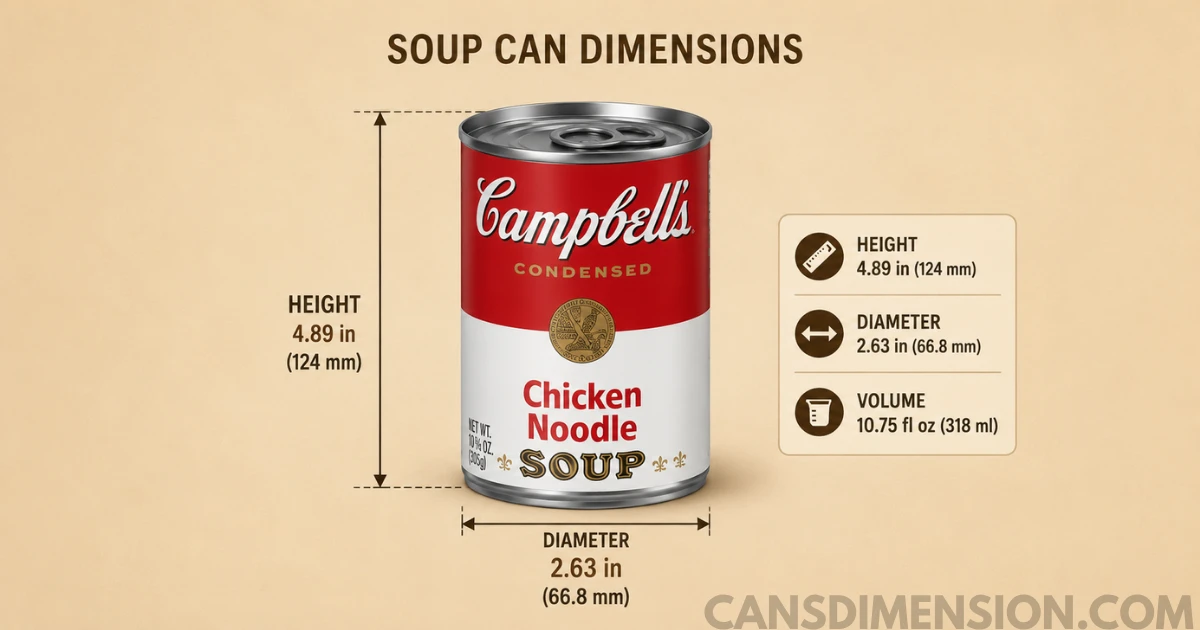
A standard
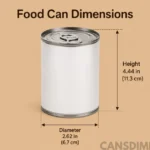
condensed soup can
measures
2.625 inches in diameter
and
4.00 inches tall.
It holds
10.75 ounces
of concentrated product. After dilution, it yields approximately
21.5 ounces
or about
2.5 cups
of prepared soup.
From the compact condensed format to the massive commercial #10 can, every size has precise specs that affect pantry storage, recipe conversions, label design, and shelf organization planning.
Soup Can Dimensions Chart
Can Type
Diameter (in)
Diameter (cm)
Height (in)
Height (cm)
Volume (oz)
Can Code
Condensed (Campbell’s)
2.625
6.67
4.000
10.16
10.75
#300
Ready-to-Eat
3.000
7.62
4.375
11.11
18.6 – 19
#303
Amy’s / Heinz
3.000
7.62
4.430
11.25
14.5 – 15
#303
Progresso
3.375
8.57
4.400
11.18
18.5 – 19
#307
Family Size
4.000
10.16
4.500
11.43
26
#401
Institutional (#10)
6.1875
15.72
7.000
17.78
102 – 105
#10
All measurements follow Can Manufacturers Institute (CMI) standards used across the US food industry. Sizes may vary slightly by manufacturer — always read the label for exact specs.
Standard Soup Can Dimensions by Size
standard-soup-can-dimensions-size
Not all soup cans are the same. Each size has a specific purpose, a specific audience, and specific numbers that matter for storage and recipe planning.
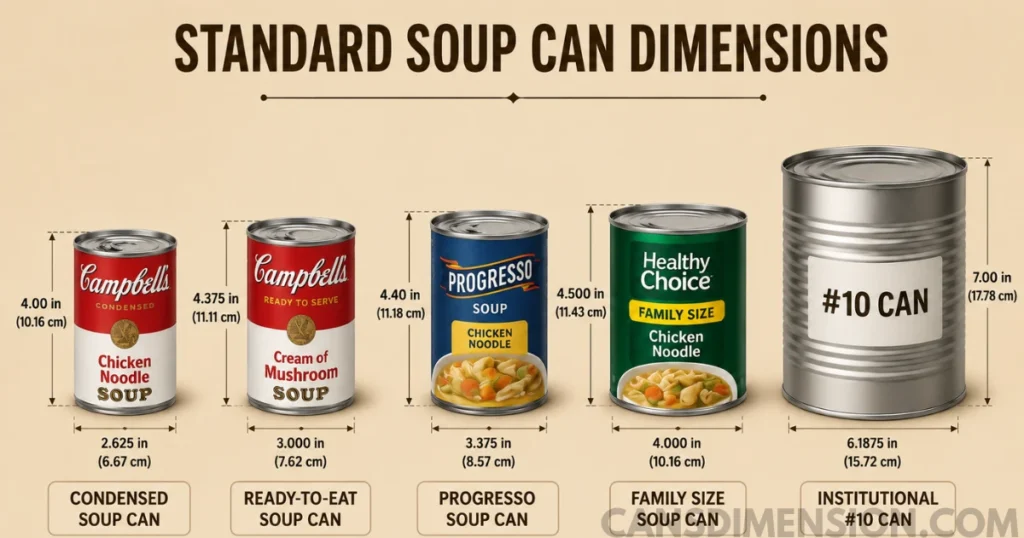
It measures 2.625 inches (6.67 cm) in diameter and exactly 4.00 inches (10.16 cm) tall. It holds 10.75 ounces of concentrated product — after dilution with one can of water, it yields approximately 21.5 ounces or 2.5 cups of prepared soup.
Ready-to-Eat Soup Can Dimensions
It measures 3.000 inches (7.62 cm) in diameter and 4.375 inches (11.11 cm) tall. It holds 18.6 to 19 ounces of product — no dilution needed. It uses the #303 industry code.
Progresso Soup Can Dimensions
It measures 3.375 inches (8.57 cm) in diameter and approximately 4.40 inches (11.18 cm) tall. It holds 18.5 to 19 ounces of product. It uses the #307 industry code.
Family Size Soup Can Dimensions
It measures 4.000 inches (10.16 cm) in diameter and 4.500 inches (11.43 cm) tall. It holds 26 ounces — approximately 3.25 cups of ready-to-eat soup.
Institutional #10 Can Dimensions
At 6.1875 inches (15.72 cm) in diameter and 7.00 inches (17.78 cm) tall, the #10 steps into an entirely different format class. It holds 102 to 105 ounces — approximately 12 cups of product.
Soup Can Size Code System Explained
soup-can-size-code
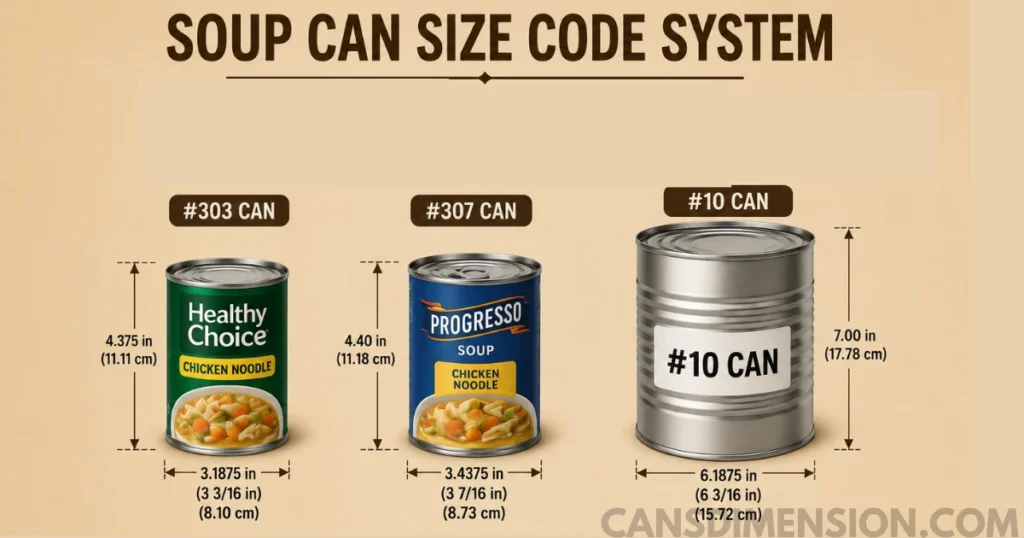
The US food can industry uses a 3-digit sizing code set by the Can Manufacturers Institute. The first digit is whole inches. The next two digits are additional sixteenths of an inch.
So a #303 can means 3 and 3/16 inches — or 3.1875 inches in diameter. A #307 can means 3 and 7/16 inches — or 3.4375 inches. A #10 can means 6 and 3/16 inches — 6.1875 inches in diameter at 7.00 inches tall.
Height comparison: A tuna can stands just 1.875 inches tall — the shortest standard food can format — because tuna is dense and does not require the volume that soup formats need.
A #10 institutional can at 7.00 inches tall holds nearly 10 times the volume of a standard condensed soup can while sharing a similar height-to-diameter ratio.
The #303 code is the most common food can in America, used across vegetables, beans, and tomatoes — which is why ready-to-eat soups using the same code look nearly identical to vegetable cans on a shelf.
Question’s
What are the standard dimensions of a condensed soup can?
A standard condensed soup can measures 2.625 inches in diameter and 4.00 inches tall. It holds 10.75 ounces of concentrated product — after dilution it yields approximately 21.5 ounces or 2.5 cups of prepared soup. These dimensions have been consistent since Campbell’s introduced the condensed format in 1898.
How tall is a standard soup can in inches?
A condensed soup can stands 4.00 inches (10.16 cm) tall. A ready-to-eat can stands 4.375 inches (11.11 cm) tall. A family-size can reaches 4.500 inches (11.43 cm). The commercial #10 can stands 7.00 inches (17.78 cm) tall.
What is the diameter of a ready-to-eat soup can?
A standard ready-to-eat soup can measures 3.000 inches (7.62 cm) in diameter and uses the #303 industry code. Progresso’s format is slightly wider at 3.375 inches using the #307 code. Both are noticeably wider than the standard 2.625-inch condensed soup can.
How big is a Campbell’s soup can?
Campbell’s Classic Condensed soup can is 2.625 inches wide and 4.00 inches tall, holding 10.75 ounces. The Chunky ready-to-eat line uses a larger can at 3.00 inches wide and 4.375 inches tall, holding 18.6 to 19 ounces.
What is the difference between a #303 and #307 soup can?
A #303 can measures 3.1875 inches in diameter. A #307 can measures 3.4375 inches — approximately 0.25 inches wider. Both stand at similar heights around 4.375 to 4.56 inches.
How big is a commercial #10 soup can?
A #10 can measures 6.1875 inches in diameter and 7.00 inches tall. It holds 102 to 105 ounces — approximately 12 cups of product. It requires a dedicated commercial can opener and accounts for roughly 30% of all foodservice packaging in the US.
What label dimensions fit a standard condensed soup can?
For a standard condensed soup can with a 2.625-inch diameter, the label circumference runs approximately 8.25 inches (2.625 × 3.1416). The usable label height is approximately 3.25 inches — the 4.00-inch body height minus 0.375 inches of seam allowance at top and bottom.
Do soup can dimensions vary by brand?
Slightly. Condensed soup cans across all brands — including store brands — match the standard 2.625 × 4.00-inch format exactly. Ready-to-eat formats vary more — Campbell’s Chunky uses 3.00 inches while Progresso uses 3.375 inches.
My name is Shehzad Ali. I am the admin and author of cansdimension.com. I write simple guides about can sizes and dimensions. I share information to help readers understand cans.